T.L. Morrisey

Showing posts with label Montreal Poetry. Show all posts

Friday, September 4, 2026

Full text of "Continuing Continuation, on Louis Dudek"


Peel Street, downtown Montreal,1970s


First published in Urban Grafitti, Edmonton, AB, 27 March 2013.

by

Stephen Morrissey


“...remember/ the paltriness of worldly claims,/ and the immensity/ that is always now.”

—Louis Dudek, Continuation III  


1

 A curious literary synchronicity: on January 4, 1963, Margaret Avison experienced a mystical experience in which she discovered her faith in God; this had a profound influence on her future poetry. On January 4, 1967, exactly four years later, Louis Dudek began writing the first of three volumes of one of the most important modern poems in Canadian literature, Continuation.   In Notebooks 1960 – 1994 (1994), Dudek writes, “The great poems tend to be great expository statement. And each such poem is a central poem for the poet in question, containing the core of his vision and thought.” That’s what is in Continuation, Dudek’s “vision and thought.”   Several years before Dudek published Continuation I, Susan Stromberg-Stein referred to it as “a poem that will possibly be his [Dudek’s] final ongoing poem, for he has subtitled it ‘An Infinite Poem in Progress.’ In this work one observes the poet combining lyrical fragments and setting them into a continuous form that has the permanence of finished poetry...” (Stromberg-Stein, M.A. thesis, McGill University, 1977)   Dudek was not interested in writing an autobiography, he had an abhorrence of sensationalism, and he rejected what he considered any egotistical drawing attention to oneself. However, Ron Everson, an old friend of Dudek’s, states in a 1983 interview that Dudek’s theme in his poetry “is his whole life.” Dudek writes, “The whole story means my whole life... But you know we say poetry, or any art, is the expression of the life of the artist, of his whole psyche, of himself on the page . . . Each poet, in fact, out of the scattered thoughts going on in his mind, makes the construct that he calls the finished poem.” (Louise Schrier interview, 1990)   How a poet handles writing about “his whole life” depends on the poet’s intention; is the poet’s voice an authentic expression of his psyche or is it ego-centric and self-promoting? As well, Dudek does not condemn strong emotion in poetry or even highly emotional confessional poetry; what he condemns is self-inflation.   Dudek’s dismissal of John Cage, and other avant-garde artists, who might have embraced and supported what he was doing in poetry, is unfortunate. Dudek writes, “John Cage: A soft-brained idiot. The purpose of his inane talk is a subtle kind of self-promotion, disguised as humility, but full of name-dropping and self-pampering.” (Notebooks, 1994)   One of Dudek’s great underlying concerns in Continuation is the passion of a life lived for poetry, a life dedicated to poetry. He describes writing poetry as an “addiction.”   Dudek lived in New York City for a number of years in the late 1940s and early 1950s and it was during this time that he came under the influence of Ezra Pound; while there he knew other poets, including Paul Blackburn. I remember Dudek telling me of knowing Blackburn, that as they walked along a city street together Blackburn climbed a telephone pole and sat on the top of it.   Dudek’s years in New York City, studying at Columbia University, meeting Ezra Pound and other artists—being in a milieu of art and creativity—are the seminal years in Dudek’s creative life.   Dudek contributed to the image of himself as conservative in his criticism of hippies, experiments in alternative lifestyles, and student rebellion in the mid-to-late 1960s; however, his earlier long poems and Continuation, a poem that is more sophisticated and avant-garde than most poetry being written in Canada today, refute this perception.   Robin Blaser writes, “They understand him to be a reactionary, which is to say that they misunderstand him.” (Infinite Worlds, 1988)   Most people who have studied Dudek’s poetry feel that he was overly influenced by Ezra Pound; however, eventually this changed and as much as Dudek had once supported Pound he later found fault with him. This is an example of the puer overthrowing the senex, it is when the children or followers of people who are significant to them finally divest themselves of the other person’s influence; the alternative is to never fully realize one’s own potential. I suspect that it is only with Dudek’s growing discontent with the importance he had given to Pound that he was able to begin writing Continuation. As an aside, I remember Dudek telling me that in all of his years of teaching he never convinced anyone of the greatness of Pound’s poetry. (See, as well, Dk/ Some Letters of Ezra Pound, ed. Louis Dudek, 1974)


2

 If having a large number of books by a specific poet, and books on that poet’s work, is an indication of a literary influence, then three significant influences on my writing have been Robert Lowell, Charles Olson, and Louis Dudek. They are poets I read and reread, poets whose work means much to me at both a personal and creative level.    In Continuation, epigrams are juxtaposed before and after other dissimilar epigrams, it is similar to the way people think, jumping from one idea to another apparently unrelated idea; in this, the poem is an “internal monologue”, that’s what Dudek called it.   Dudek’s Continuation is a post-modern poem attacking post-modernism and extolling the modernist movement.   Continuation is similar to a painting by Jackson Pollock, there is no narrative or focal point to observe, every part of a painting by Pollock is equal to every other part of the same painting. Similarly, every part of Continuation is equal, although different, to every other part, there is no narrative leading up to a climax in the poem.   There are two ways Dudek could have written (or “assembled”) Continuation, both presume that he already had the epigrams, short statements, and other fragments of writing that make up the poem. The first is by taking these fragments and putting them together in a random way. The second method would be to take all of the fragments and consciously piece them together giving the poem the appearance of a random organization.   Among the poets who influenced Dudek is Stéphane Mallarmé whose poem, Un coup de dés, is important to the writing of Continuation.   Three “epigrams” from John Cage: “I have nothing to say and I am saying it and that is poetry.” “The goal is not to have a goal.” “As far as consistency of thought goes, I prefer inconsistency.”   Dudek was always concerned about irrationality and the artist; he seemed to posit a connection between irrationality and the very people that he felt threatened the old, established order.   I think of Margaret Laurence’s novel, A Jest of God, with the blue faced barbarians waiting to invade the walled villa where children are playing with no idea of their possible destruction. What threatens to disintegrate society and destroy propriety—“barbarians” as Dudek described them—is always present.   Always present in Dudek’s work is the belief in the transcendent power of poetry. Poetry and art were accorded an almost religious quality by Dudek; his desire was to reinvent poetry and, like Ezra Pound, to “make it new”.    Dudek was always aware of the small readership for poetry and how inconsequential poetry is for the great majority of the population. (As many people die on the roads on a holiday weekend as read poetry Dudek once said.)   It’s a mystery how poems come to be written. It could be that writing poetry mostly comes in short bursts of inspiration (to inspire, to breathe in spirit); Continuation, a long poem, has the intensity of many short poems, or epigrams, put together.   Dudek is fairly relentless in his criticism of both Northrop Frye and Marshall McLuhan, two highly distinguished Canadian scholars and critics. McLuhan, like Dudek, was very much involved with Ezra Pound in the late 1940s and early ‘50s.   Marshall McLuhan’s “probes”, his epigrams, are insightful and cause the reader to understand, in a new way, the digital and electric media that is so much a part of the world in which we live.   Three epigrams from Marshall McLuhan: “Discovery comes from dialogue that starts with the sharing of ignorance.” “Any highway eatery with its TV set, newspaper and magazine is as cosmopolitan as New York or Paris.” “The story of modern America begins with the discovery of the white man by the Indians.”   McLuhan, who was conservative and a religious person, was one of the first academics to explain the new technological environment in which we live.   McLuhan writes: “I believe that our survival, and at the very least our comfort and happiness, is predicated on understanding the nature of our new environment, because unlike previous environmental changes, the electric media constitute a total and near-instantaneous transformation of culture, values and attitude.”   Dudek and McLuhan were writing and thinking from two different perspectives. Dudek’s is the world of poetry; he writes from a perception of the eternal and the infinite. McLuhan’s is the world of temporality, he is writing of a contemporary and changing world of electric media.   I never agreed with Dudek’s negative assessment of Northrop Frye; indeed, I wonder if there wasn’t some bitterness regarding Frye on Dudek’s part, especially after reading Frye’s mean-spirited 1955 review of Dudek’s Europe (1954); Frye writes: “... I find large stretches of the book unrewarding. In the first place, the influence of Pound is oppressive. Pound is everywhere: the rub-a-dub three- and four-accent, the trick of snapped-up quotations and allusion, the harangues against usura, the toboggan-slide theory of the decline of Europe after the Middle Ages, and so on. In the second place, the conversational style brings the ideas into sharp relief, and the ideas are commonplace, prejudice reinforced by superficial tourism...”   In a 1965 article in The Tamarack Review, Dudek writes, “I consider both McLuhan and Northrop Frye as really poets manqués, best appreciated when we read their speculations as imaginative constructs made out of their real materials, not as ‘objective’ or ‘scientific’ theories at all.”   A coincidence of dates: Valerie Eliot, T.S. Eliot’s widow, has just died, reported in the newspaper for 16 November 2012. The obituary states that T.S. Eliot died on January 4, 1965, two years to the day after Margaret Avison’s religious experience and two years before Dudek began writing Continuation I.   Louis’ cousin and close friend, the artist Stanley Roznyski, passed away on December 9, 2012. Born on February 21, 1931, he grew up near where Louis lived in the east end of Montreal. Roznyski has a moving eulogy for Louis in Eternal Conversations, Remembering Louis Dudek (2003).   Dudek writes: “…you can’t write good poetry because you’ve read many books or because you think great thoughts. Poetry is a mysterious process that happens to very few individuals, and they are not fortunate in it. (Emily Dickinson and Thomas Trehearne, completely unknown in their time; Blake and Holderlin, cursed with mental ills and isolation.)” (Poetry Canada Review, early 1990s) This reminds me of the lack of recognition Dudek felt his own poetry had received and his sense of isolation as a poet and a person. Robin Blaser describes Dudek as a “walking loneliness”. (Infinite Worlds, 1988)  


3

Three quotations from The Other Voice, Essays on Modern Poetry (1990), by Mexican poet Octavio Paz: “What is an ‘extensive poem’? The dictionary says that to extend is to increase something so that it occupies more space. To extend also means to expand, to develop, to enlarge, to unfold, to occupy greater terrain. In its original and primary sense, extension is a spatial concept. Hence an extensive poem is a long poem. Since in language words come one after the other in a row, an extensive poem is one that has many lines and the reading of which takes a considerable amount of time. Space is time.” “A great change: the first-person singular becomes the main character of the extensive poem.”  “The best example of the new poetics was Un coup de dés, a strange poem that has as its subject the act of writing a poem. But a poem never before attempted: an absolute poem. Not a poem on the poem but the poem on the poem.” In light of Paz’s definition, Dudek’s Continuation is an “extensive” poem.   Dudek suggests that his epigrams are a way for him to write poetry, they are the first line of a poem that proceeds to other epigrams and disparate lines and then a whole poem; or, he juxtaposes epigram after epigram in a kind of free floating mix of confused random associations that eventually, in a synergistic way, take on more meaning than if the epigrams were presented individually; this is how Continuation is similar to some of Cage’s writing in which dissimilar statements are juxtaposed together.   Meaning” in Continuation is achieved by the repetition of epigrams (and other fragments of writing) with similar ideas; otherwise, on first reading, the poem seems “meaningless”.   In other words, as one might expect, this is not “traditional” poetry.   The “problem” with 1940s/1950s Abstract Expressionism—the art of Jackson Pollock, Franz Kline, Marc Rothko and others—is that despite its relative popularity, more people wanted art to be a representation of “reality” than total abstraction. Abstract Expressionism was superseded by Pop Art—the art of Andy Warhol, Claes Oldenburg, Robert Rauschenberg, and others—an art extolling in an ironic way the very popular culture, or low art, that the previous generation of Abstract Expressionist artists condemned. This was suggested in John Logan’s play on Marc Rothko, Red.   Pierre Trudeau’s epigrammatic statement, “Reason over Passion”, was later used in an ironic way, it was sewn onto a quilt by the artist Joyce Weiland and is on exhibit at the National Gallery of Canada in Ottawa.   Dudek began Continuation when he was 49 years old, a month later he turned fifty; the concept for how to write the poem was discovered by Dudek in 1956, when he was only thirty-eight years old; however, Dudek tells us that he could only write Continuation after he discovered his authentic voice, one that was a memory of his thought processes when he was a child. With this in mind, Continuation is Dudek’s life-long work, his life opus.   Dudek’s Continuation is one of the most radical poems in Canadian literature, “radical” meaning to go to the roots of poetry and language.    A common idea among Jungians is that “the brighter the light the greater the darkness.” Dudek’s emphasis on rationality hides the irrational dark side of the poet.   Dudek’s conservative persona is a mask worn by a poet whose life was lived quietly and conservatively but whose mind and imagination were open to a multiplicity of thoughts and creative ideas.   Rationality is a veneer of conscious order over the depth and many layered complexity of the unconscious. See C.G. Jung’s Red Book (2009) for a description of the journey into the unconscious mind.   All art is vision, or else it is the repetition of the past.   Continuation is, in some ways, one of Dudek’s “travel” books, but this is not travel to a place as was Europe (1954) or En México (1958); this is a journey across time, it is the journey of a poet’s life during middle age to old age and preparation for death; the last poems in Continuation III, including his final reflections on life, must have been written only months before Dudek’s passing.   In these final poems, Dudek returns repeatedly to the concept of time as infinity, he envisions an ultimate “shining” that illuminates the darkness of ignorance with a kind of mystical perception of life.

__________________________


This essay is dedicated to two friends—Richard Sommer and Keitha K. MacIntosh—both of whom I met in the early 1970s and both of whom passed away in 2012. I am grateful for having known them, and for their kindness and generosity to me.


Note: This essay continues the work begun in my essay Reading Louis Dudek’s Continuation: An introduction to a major Canadian poem.


Stephen Morrissey

    November 2012 – April 2013 • Montreal


Monday, August 31, 2026

Full text of "Reading Louis Dudek’s Continuation: An introduction to a major Canadian poem"


Ste. Catherine street, downtown Montreal, 1954

First published in Montreal Serai, December 2013

by Stephen Morrissey


Louis Dudek was one of my professors at McGill University, later he became a friend. As I’ve written elsewhere, what brought me to McGill as a graduate student in 1974 was the desire to study with Dudek. It was one of the best decisions I’ve made in my life. Dudek was a wonderful teacher; but, in addition to his teaching, he gave me something that profoundly changed my life: it was the gift that all young poets need, it is the confirmation of the value of their work by an older poet.

__________________________


In Paradise, Essays on Myth, Art, & Reality, Dudek writes: “In 1958 I published a book with a new kind of private meditative rhetoric, En México, and in the following year I wrote a poem, ‘At Lac en Coeur,’ with an even more quiet and introspective bent, the beginning of all my later poetry. After that I wrote the first draft of Atlantis, in the form of a continuous meditation, in 1961. (It was published in 1967.) Since then, I have been writing a poem called Continuation, in the same manner—at times even more extreme as a private language—which I expect to go on with until the end” (Dudek, 1992, p. 81).

 __________________________


Continuation is Louis Dudek’s major work, a poem in three volumes that preoccupied the last forty years of his life. The poem is difficult for many readers due to its conversational and fragmentary style; indeed, at times Continuation seems a hodgepodge of unrelated statements (for an example of this, please see Appendix below). Dudek’s concerns—for instance, the negative influence of the media on society, the importance of the arts, what it being a poet means, rational thinking in an irrational world, and growing old—are all present in the poem. These concerns are essential to Dudek’s writing, vision, and his long literary career, but before most readers can begin to appreciate these concerns in Continuation they need the key to understanding the poem: the key is Dudek’s use of epigrams.

__________________________


The publishing history of Continuation is interesting; Continuation I and Continuation II were published as separate volumes by Vehicule Press; Continuation III is more confusing as parts of it were published in two separate books:


Continuation I (Vehicule Press, Montreal, 1981), five sections.


Continuation II (Vehicule Press, Montreal, 1990), twenty-one sections.


Continuation III, found in The Caged Tiger (Empyreal Press, Montreal, 1997), has four sections; however, later Dudek said that “Bits and Pieces”, included in The Caged Tiger, was section five of Continuation III; Dudek’s last book, The Surface of Time (Empyreal Press, Montreal, 2000), includes “Finale”, which is section six of Continuation III.

_________________________


Susan Stromberg-Stein and I were both students in Dudek’s graduate seminar “The First Person in Literature”, fall-winter semester 1974-1975. I will quote from Stromberg-Stein’s Master of Arts thesis, “Louis Dudek, A Biographical Introduction to his Poetry” (McGill University, 1977), which gives a date for when Dudek began writing Continuation: she writes, “The idea for ‘Continuation 1’ came to him while he was still writing Atlantis in 1961”; then she quotes from Atlantis:


I said to my friend, “Don’t read this,

   it’ll make you dizzy.”

But she read on, said she couldn’t stop.

   “What is it?”

I said: “The vertigo of freedom.”

Why stop at all, she said, why not go on?

“Of course I can’t stop,” I said.

(Stromberg-Stein, 1983, p. 88)


The dates for Continuation would therefore be: genesis of the concept of assembling fragments of thoughts and images into a long poem, later used in its most fragmentary form in Continuation,  occurs around 1956 when he was writing En México which was published in 1958 (Dudek states, “En México is made of fragments...”, interview with Louise Schrier); reference to the first tentative composition of Continuation, found in Dudek’s long poem, Atlantis, was written in 1961; and the actual composition of Continuation begins on 4 January 1967 (see the holograph of the first page of the poem in the Louis Dudek issue of Open Letter, 1981).

__________________________


In Continuation Dudek is creating a multi-book long poem. This type of project requires maintaining creative inspiration and a long term commitment to a structure and themes that will be repeated in the subsequent books. By “multi-book long poem” I am referring to the major long poems written in the 20th century in the English language, dominated by American poets; the major works are: Ezra Pound’s Cantos, William Carlos Williams’s Paterson, Charles Olson’s Maximus, and Louis Zukofsky’s A (there are other single or multi book-length poems, but these are the important titles). Dudek is critical of all these poets and he gives various reasons for his criticism; indeed, his criticism of them is a way of explaining what he perceived as the errors these other poets made in their work, errors he wanted to avoid. Perhaps he is also laying his claim to the long poem form and making room for his own work, with no deference or condescension to any who came before him. His previous book-length long poems—Europe, En México, and Atlantis—were all significant works, but they were also preparation for Continuation.

__________________________


The whole of Continuation is a series of meditations and reflections on life in the late twentieth century; the following epigram shows the seriousness with which Dudek approached his art:


“Art and the artist,” I said, “is our religion”

                        Art is the true religion

(Dudek, 1990, p. 73)

__________________________


In his preface to Continuation One, Dudek states that the poem “is a record of poetic moments and fragments. . . that I think of as coming from an underground stream, a poetic gurgle that goes on behind the other concerns of life, like an obsession, and pertains more to the mind’s essential working than to any imposed pattern. If it has an order it is an order in the nature of the mind itself, or of the world we live in, not in poetic traditions or in ideas consciously held.”

__________________________


Dudek admired the writings of Henry Miller, someone with whom he corresponded and at one time wanted to publish. One winter afternoon in the mid-1970s, on a city bus home from McGill, when I expressed to Dudek my enthusiasm for Henry Miller’s fiction and non-fiction, he told me of his own admiration for Miller’s writing. At first glance this is a curious association, Miller seems one of the most dissimilar writers to Dudek; however, Dudek stated that his ideal for his own poetry is to write in the conversational style of Henry Miller but always maintaining the critical faculty of Matthew Arnold. In Continuation Dudek is able to combine what he learned from Miller and Arnold and communicate his own poetic vision.

__________________________


There are several influences on Dudek’s work, for instance Ezra Pound, Henry Miller, and Matthew Arnold. An important although less known influence is the French poet Stéphane Mallarmé.  Mallarmé’s influence on Dudek’s work is in the use of chance or randomness and the fragmentary effect it has on the poem. Continuation has a kind of anarchic quality, it is a montage of disparate epigrams or statements. Dudek states, in a 1992 interview with Laurence Hutchman, “If you go back to the seventeenth century, the emblem poems in which a poem imitates the shape of something, well, that was the first of its kind. Then, the next important step, I would say, is Mallarmé and the poem Un coup de dés, “A throw of the dice,” where the words are scattered, because he’s trying to say something about chance. Un coup de dés n’abolit pas le hazard (A throw of the dice does not abolish chance). Of course, rather a self-evident statement. Anyhow, that’s a wonderful poem of Mallarmé’s that had a powerful effect upon me” (Hutchman, 2011, p. 113).

__________________________


“…it is his (Pound’s) didactic obsession behind the whole ideogrammic show…” (Dudek writing in a Poetry Canada Review article, early 1990s). But the same can be said for Dudek’s epigrams: in a 1988 interview with Louise Schrier, Dudek states: “So his [Pound’s] Cantos are composed of a series of such ideograms: presented pieces of history, examples of Malatesta, examples of Confucius saying this or that; and out of these concrete examples and instances the great epic develops. My method is analogous to that really, but it doesn’t come from Pound. It comes from the original source of Imagism itself” (Schrier, 1990, p. 44). But the original source of Imagism includes Pound’s ideograms and Dudek’s epigrams reveal his own didactic obsession... 

__________________________


Dudek’s epigrams are similar but they are not the same as Pound’s ideograms. Pound’s concept of the ideograms—developed from a manuscript given to Pound by Ernest Fenollosa’s widow—present the ideogram or Chinese written character as a visual concept—an image—available to poets; later this was developed into an aesthetic device that can be found in the Imagists’ manifesto and poems. Dudek’s epigrams are short concise statements, mostly lacking a visual quality, that develop into poems.

__________________________


I remember Louis showing me the manuscript of his Epigrams before it was published, typed on onion skin paper, in his office at McGill. The epigrams are important to Dudek and especially to understanding his work in Continuation.  One of the epigrams reads: “Epigrams are one-line poems. A lot of them together are like a long poem” (Dudek, 1975, p. 38). That “long poem” is Continuation.

__________________________


Dudek’s epigrammatic insights are conversational, presented as though one is listening to someone talking. It’s an informal style of writing, as Dudek’s attention jumps from one observation to another; however, there is cohesion to what he is talking about; many epigrams are variations that share the same subject. The structure of the poem is organic and verbal. Continuation could have been filmed with Dudek speaking the poem as he walks on Mount Royal or along a street in Montreal.

__________________________


Dudek: “...if you look at Continuation 1 and 2 you may say, ‘What he’s got here are variations.’ As Mike Gnarowski said, ‘You know, you’re saying the same thing over and over.’ I never repeat myself entirely, but actually if you examine it, and you number these things or see them in different colours, you might get a sense of variation in the way it occurs. It’s the way the ideas turn and return (Hutchman, 2011, 114).”

__________________________


Year ago, Dudek suggested to me that to write a poem one needed a good first line or sentence, something aphoristic, epigrammatic, or otherwise memorable. Any successful poem that I’ve written begins with just such a sentence that seems to initiate a stream of writing and then a poem. I had already described my writing technique, in A Real Good Goosin', Talking Poetics, Louis Dudek and The Vehicule Poets (1981) as “cranking it out”. A few years ago, rereading this comment, I was embarrassed by it, I felt “cranking it out” was flippant, that it lacked seriousness, but as I thought about it I returned to thinking of my own approach to composition and “cranking it out” seems a good way to write a first draft. That is, to write without the apparent burden of preconceptions and self-censorship. For Dudek, a first line or sentence with which he could begin writing a poem was the epigram; either the epigram inspired the writing of the poem, or the epigram was the first good line or sentence that begins a poem, or the epigrams are the poem.

__________________________


In his Notebooks, 1960 -1994, Dudek writes, “Aphorisms (epigrams) give you more for your time and money than any other literary form. Only the poem comes near to it, but then most good poems either start off from an aphorism or arrive at one: ‘April is the cruellest month...’ ‘We must love one another or die.’ ... Aphorisms and epigrams are the corner-stones of literary art” (Dudek, 1994, p. 52).

__________________________


John Cage, one of the most experimental composers of the last century, was also a poet; towards the end of his life Cage served as Poet Laureate of the United States at the Library of Congress in Washington, DC. Cage’s long poem, “How to Improve the World (You’ll Only Make it Worse)” is a random assemblage of statements, it is described by Cage as “a mosaic of ideas, statements, words, and stories...” (Cage, 1967, p. 3). This could just as easily be a description of Dudek’s Continuation. I don’t think there is any poet whose work comes closest in concept to Dudek’s in Continuation than this work by John Cage; unfortunately, as was the case of Dudek’s rejection of Marshal McLuhan’s work, and the work of other avant-garde artists and thinkers of his generation, Dudek also rejected Cage.

__________________________


What seems “meaninglessness” in Continuation gives way to what is “meaningful”, you just have to keep reading long enough to see what the poem is all about. Meaning is achieved by the repetition of epigrams that share a similar idea; however, these epigrams are not conveniently grouped together. Dudek juxtaposes epigrammatic statements in a random non-linear way, but out of what seem “meaningless” statements comes a wholeness, a sense of Dudek’s unified vision. In the very act of the random assemblage of epigrams comes a new meaning and vision.

__________________________


Dudek, like many other Post-Modern writers, ended up writing an open-ended and almost “structureless poem”; this is one aspect of the movement of poetry in the 20th Century and it is partly what made sonnets and ballads obsolete forms. This is also what Jackson Pollock was attempting in his paintings. Visual artists, like Pollock, aimed at creating art by circumventing the limiting imposition of the ego on the work. Continuation, in terms of visual art, is closest to the action paintings of Jackson Pollock; it is art that has no center and no narrative, for every part of the surface of the painting is the “center” just as every part of Continuation is the center of the poem.

__________________________


I can now see that what Dudek liked about my visual poem, regard as sacred the disorder of my mind (in The Trees of Unknowing, 1978, for which he also wrote an Introduction), is the epigrammatic aspect of it, as well as the use of white space indicating silence, and that the poem can be read by one or by many voices simultaneously. All there is to the poem is the single line, regard as sacred the disorder of my mind. It is a concrete poem using a line from Arthur Rimbaud’s Season in Hell, revisioned and reworked into a visual poem for voices.

__________________________


One day—it was the afternoon of January 9, 1979—I was with Louis Dudek and Lionel Kearns, who named his son Louis after Dudek. We had something to eat at a food court after Lionel’s reading. My then wife was pregnant but was not expecting to give birth for another four weeks. This was the one time I went off by myself, other than going to work, while my wife was pregnant. I arrived home around 5 p.m., the flat was in darkness, and I found an almost illegible note scribbled by my mother-in-law, telling me to go to the hospital, that there were problems with the pregnancy. A neighbour drove me to the Montreal General Hospital where my son had been born prematurely. This is where I was when my son was born, not in the birthing room at a major hospital, but with Louis Dudek and Lionel Kearns talking poetry in a food court in downtown Montreal.

__________________________


“Some epigrams come provided with a grain of salt, called wit.” “An epigram is the shining jewel in the watch. There is no good poetry without some element of epigram in it.” “A good poem improves, and a bad poem gets worse, as time goes by.” All three of these epigrams can be found in Small Perfect Things (Dudek, 1991, p. 90-91). More than a decade after his passing we are just now catching up with Dudek’s work. Dudek’s poems are not dated or clichéd, as I stated in my essay on Dudek, “The First Person in Literature” (Collins, et al. eds, 2003), his poems are more relevant now than when they were originally published.

__________________________


“I think of the long poem, the stream of fragmentary but authentic inspiration, as the most important development of modernism, although this has not yet been much realized or acknowledged by anyone. It is a form of immense possibility for the future” (Dudek, 1994,

p. 59). In this statement, Dudek could be describing Continuation, for Continuation is one of the great Canadian poems of the twentieth century, it is a truly original work of poetry unlike anything previously written. Indeed, Continuation is Dudek’s greatest work, it is part of his enormous literary legacy as a poet, critic, and man of letters. 

_________________________


Note: My thanks to Laurence Hutchman for the gift of Continuation II, which got me writing these notes. My thoughts turn to my friends, the late Sonja Skarstedt and her husband Geof Isherwood. They were Louis’s dear friends and support in his old age and published, with Empyreal Press, his last books. Sonja, still missed by her friends.


When I made enquiries about Empyreal Press and their relationship with publishing

Continuation III, Geof Isherwood informed me that the work for Empyreal Press was “99% Sonja’s effort.” Her literary papers are housed at Mount St. Vincent University in Halifax, Nova Scotia.


                                  November 2012 – February 2013 • Montreal


Appendix


In order to give the reader a clear example of the fragmentary nature of Continuation, that is, of Dudek’s deliberate random assemblage of unrelated sentences, lines, epigrams, phrases, and observations, I include the following quotation from Continuation One:


Say it


As the true mimesis

                        a poem without direction


When they make dried fruits

            think of what goes off in the air

‘You could breathe and live’


‘Miss Collins, what is a hundred and four over n?’


The carrot greens are hanging out of the garbage bag

They have served their purpose


Necessity is the will of God

What he wants most is to exist


Wish you were here

                        having a good time


I am the imagination that creates

                                    an image of itself


The poets have been trying to conceive man

Now they want to be as well as to conceive


So Ezra was ok

                        He survived our misunderstandings


As the body disintegrates, the spirit grows more firm


He said, ‘Nothing can help,

The turbulence inside is not responsive to rationality’


And so went away

The gnarled features, face like a battered hammer,

                        and fists bleeding poems


To walk with twinges

of pure pain punctuating every step,

                                    fight the violence erupting


Try to make language live—

                                                the sun’s gift


O for a few analyzable poems

that with a little mortar one might fit

                                    into a history of philosophy


To realize what we are, as living,

at the same time that we live on the page


Since poetry is like God, the one necessary element

missing from all we know


The nursery at six o’clock

                                    an action painting


(Continuation One, pages 20-22)


Works Cited


Cage, John. 1967. A Year From Monday, New Lectures and Writing. Wesleyan University Press. Middleton, Connecticut.


Dudek, Louis. 1975. Epigrams. DC Books, Montreal.


Dudek, Louis, the Vehicule Poets. 1981. A Real Good Goosin', Talking Poetics, Louis Dudek and The Vehicule Poets. Maker Press, Montreal.


Dudek, Louis. 1981. Open Letter. Issue dedicated to Louis Dudek. Spring & summer, nos. 8-9. Toronto.


Dudek, Louis. 1981. Continuation I. Montreal, Vehicule Press.


Dudek, Louis. 1988. Robin Blaser (ed.).  The Infinite World, The Poetry of Louis Dudek. Vehicule Press, Montreal.


Dudek, Louis. 1990. Continuation II. Montreal, Vehicule Press.


Dudek, Louis. Interview by Schrier, Louise. 1990. Zymergy, # 8. Montreal.


Dudek, Louis. Early 1990s. Poetry Canada Review, Vol. 15, No. 1.


Dudek, Louis. 1991. Small Perfect Things. DC Books, Montreal.


Dudek, Louis. 1992. Paradise, Essays on Myth, Art, & Reality. Vehicule Press, Montreal.


Dudek, Louis. 1994. Notebooks 1960 – 1994. The Golden Dog Press, Ottawa.


Dudek, Louis. 1997. The Caged Tiger. Montreal, Empyreal Press, Montreal.


Dudek, Louis. 2000. The Surface of Time. Empyreal Press, Montreal.


Dudek, Louis. 2011. Interview by Hutchman, Laurence. In the Writers’ Words, Conversations with Eight Canadian Poets, Guernica Editions, Toronto.


Morrissey, Stephen. 1978. The Trees of Unknowing. Introduction by Louis Dudek. Vehicule Press, Montreal. 


Morrissey, Stephen. 2003. ‘The First Person in Literature’ in Eternal Conversations, Remembering Louis Dudek. Collins, Aileen, Skarstedt, Sonja and Gnarowski, Michael (eds). DC Books, Montreal.


Stromberg-Stein, Susan. 1983. “Louis Dudek, A Biographical Introduction to his Poetry”. Golden Dog Press, Ottawa.


Friday, November 7, 2025

Sonja Skarstedt on a poem by F.R. Scott


In an old booklet of poems by the McGill Group of Poets, at the bottom of F.R. Scott's poem "trees in ice", Montreal poet Sonja Skarstedt writes, "I spoke to FRS at McGill in 1981 & he explained to me that he wrote this poem in memory of a time during his boyhood in Quebec City--he recalled the winters when he glanced out of his window & saw the black, bare branches encased in clear ice." So, now, anyone doing research on Scott's poems has this to include. 

This untitled booklet has poems by the McGill Group of Poets--Frank Scott, AJM Smith, AM Klein, and Leo Kennedy. Maybe the booklet was used in a class on Canadian poetry, it doesn't have a publisher, a title, an ISBN, a date, and it is unpaged, but it is a good short introduction to the poems of these important Canadian poets. 

Wednesday, February 7, 2024

"Laurentian Shield" by F. R. Scott

Events and Signals, F.R. Scott,
Ryerson Press, 1954


Hidden in wonder and snow, or sudden with summer,
This land stares at the sun in a huge silence
Endlessly repeating something we cannot hear.
Inarticulate, arctic,
Not written on by history, empty as paper,
It leans away from the world with songs in its lakes
Older than love, and lost in the miles.

This waiting is wanting.
It will choose its language
When it has chosen its technic,
A tongue to shape the vowels of its productivity.

A language of flesh and of roses.

Now there are pre-words,
Cabin syllables,
Nouns of settlement
Slowly forming, with steel syntax,
The long sentence of its exploitation.

The first cry was the hunter, hungry for fur,
And the digger for gold, nomad, no-man, a particle;
Then the bold commands of monopolies, big with machines,
Carving their kingdoms out of the public wealth;
And now the drone of the plane, scouting the ice,
Fills all the emptiness with neighbourhood
And links our future over the vanished pole.

But a deeper note is sounding, heard in the mines,
The scattered camps and the mills, a language of life,
And what will be written in the full culture of occupation
Will come, presently, tomorrow,
From millions whose hands can turn this rock into children.

Tuesday, July 17, 2018

R.G. Everson's "Everson at Eighty"

R.G. (Ron) Everson was a prominent poet back in the 1950s and 60s, he is also one the founders of the League of Canadian Poets. Like many of the older generation of poets you don't hear much about Everson today. I just read Everson at Eighty (Oberon Press, 1983) which also has an introduction by his friend Al Purdy. Purdy is supposed to have edited this selected poems, but it's a bit confusing if he really did and there are parts of his introduction that are also confusing; for instance, he writes of going on a trip to Newfoundland with the Eversons but also present on this trip was Purdy's wife and her husband, but the husband he is referring to might in fact be Purdy himself, referred to in the third person, or it might be some other man who is married to Purdy's "wife". It just doesn't make sense. Thirty-five years after it was published, Everson at Eighty is still worth reading.

As an aside, in the early 1970s I heard Al Purdy read his work at Loyola College (now the Loyola Campus of Concordia University) and after the reading, in the faculty lounge, I met Everson who had been talking with his friend Al Purdy. Poetry was a small world in the old days but that small world was populated with a pretty talented group of poets.


1983


Sunday, July 15, 2018

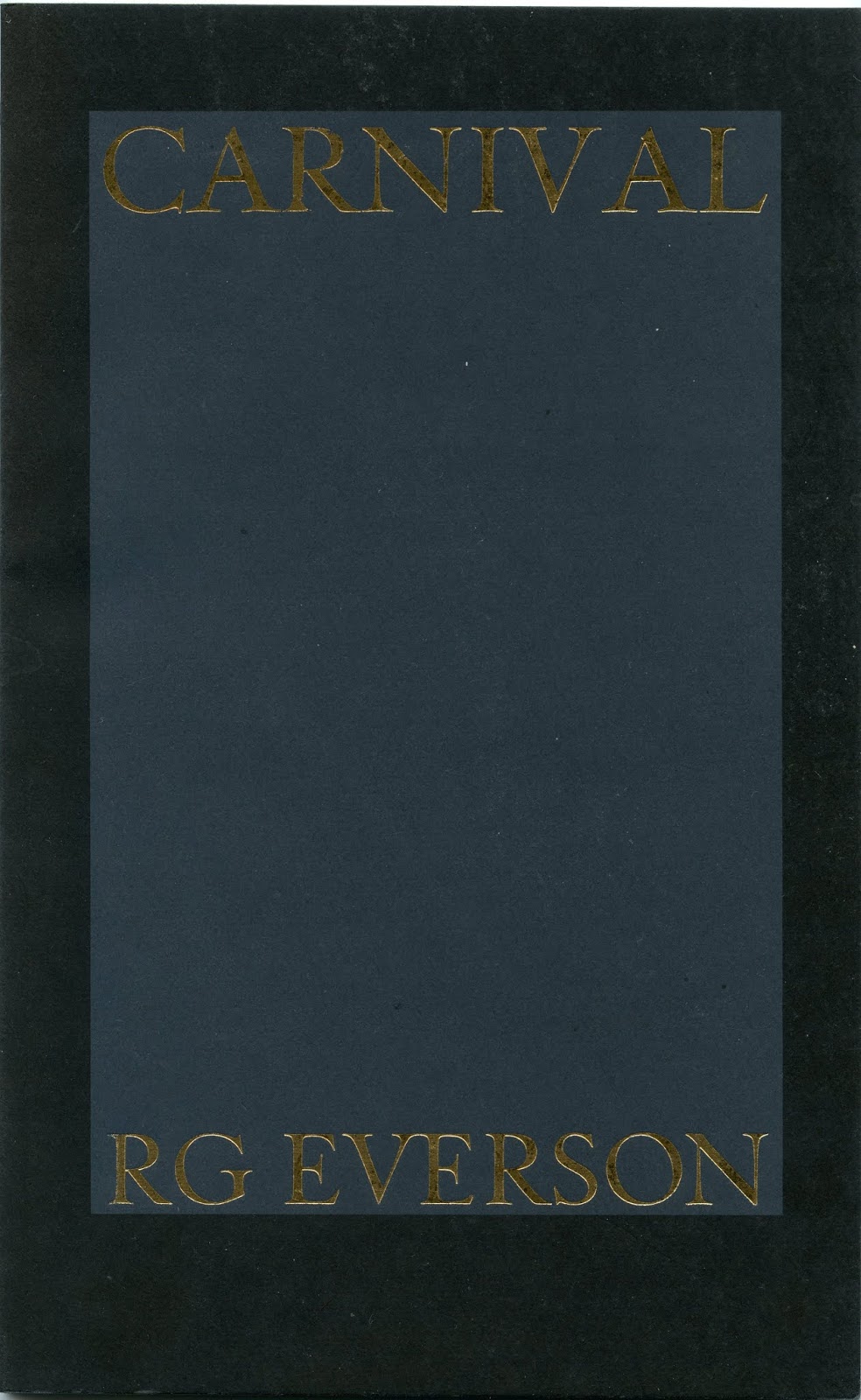
R.G. Everson, 1903-1992

I've been reading and enjoying R.G. Everson's poetry for many years. Ron Everson (1903 - 1992) was a Montreal poet, he was also a lawyer who never practised law and who spent most of his career in public relations. His extensive literary archives are at McMaster University; he has a voluminous correspondence with other well-known poets, he published more than ten books of poetry, he was published in important periodicals (for instance, in Poetry (Chicago). Al Purdy, Earle Birney, Irving Layton, and Louis Dudek were all his friends, other poets thought highly of his work. His poetry is accessible without being simplistic, and despite all of this he's largely forgotten or ignored. The only missing ingredient, and possible failing, in Everson's body of work is a single (or several) highly impressive poems by which he can be recognized and known. He was a good technician although not a great poet, but still a poet who is enjoyable to read. He published most of his books in his last twenty years, I guess he was trying to catch up on lost time after spending so many years away from the Muse and toiling in the PR business. In 1960 Everson and his wife lived at 4855 Cote St. Luc Road, apt # 608, in Montreal; they spent their winters in Florida.  

1976


1969

1978

1965


1957


R.G. Everson's home in this apartment building,
on Cote St. Luc Road, Montreal

Tuesday, October 9, 2012

Remembering Keitha MacIntosh


The last time I met Keitha MacIntosh was in the early-1990s, it was at a Greek restaurant that she often frequented and where she sat for hours drinking tea and correcting her students’ papers. This was the first time I’d seen Keitha for many years, from when I used to give poetry readings to her classes at Vanier College in the early 1980s. In early September 2012 I heard from Keitha’s daughter, Susan Hull, that Keitha had passed away.

 I first met Keitha in the fall of 1972, in Richard Sommer’s creative writing class at Sir George Williams University. Perhaps she was fifteen years my senior, and we became friends during that time. The 1970s were an important time in Montreal poetry, it was the time of a poetry renaissance here. Keitha’s contribution to this renaissance is her magazine, Montreal Poems, that she edited and published. In it you can find the early published work of Artie Gold, Richard Sommer, Ken Norris, Carole Leckner, Ray Filip, Sharon H. Nelson, Ross Leckie, Marc Plourde, Steve Luxton, Claudia Lapp, Mona Adilman, Mary Melfi, Guy Birchard, myself, and others. All of these poets have since made a contribution to Canadian literature.


There is a large correspondence between Keitha and myself, archived in my literary papers at McGill University’s Special Collections, at the McLennan Library. From 1975 to 1984, in all, 137 letters went back and forth between us. We wrote to each other about other poets, Montreal Poems, and life in general. She wrote and published a poem about me, “Stephen's Day”, that I still find deeply moving. She shared with me her enthusiasm for writing and never doubted that I was the poet she believed I was.

After she married, Keitha and her husband ran a dairy farm in Dewittville, Quebec, but as Keitha became more independent she wanted a place of her own. She was a writer for many years before we met and her creative life began late at night when she was alone and writing. After the farm was sold she lived in a trailer until restoration of her 200 year old log cabin was completed. I visited her at the trailer and later at the log cabin. One evening, around 1981, I was invited over to meet Sharon H. Nelson; Keitha went on to publish some of Sharon’s work. After Keitha’s Poems of the Chateuguay Valley was published I reviewed her book in the Huntingdon Gleaner thinking Keitha would be happy with this recognition of her work; it was a mistake on my part as she was upset that her writing life was revealed to her neighbours. There was a firm dividing line between her writing and how much she wanted her rural community to know about her.

There are many women today who hold prestigious positions in business, academia, and government, but Keitha was born at a time, and in a society, that was conservative regarding a woman’s role in society. It is important to remember that Keitha was a highly intelligent woman; however, this very intelligence and her desire to be a writer made it difficult for her to accept the life of a farmer’s wife, a life that many other women (just as intelligent as Keitha) would have found fulfilling. What set Keitha apart from other women is a combination of things: she was introverted and very sensitive; her life was pulled in two different directions, her desire to fulfill her life and be a writer and the demands of a domestic life.

Keitha had been a registered nurse before earning her B.A. and M.A. degrees; she was a professor of English at Vanier College for twenty-two years. She was a writer for many years before we met. She read widely and she was an excellent teacher. She was a good and generous friend to many of us. She was always on the side of the underdog, whether for women’s rights, or for Natives and French Canadians who had been dispossessed by the newly arrived English, or English-speaking Quebecers whose rights had been denied by the French. Keitha was also active in promoting literacy and access to books. She co-founded the Little Green Library, located in Huntingdon, in 1972.

In the mid-1980s, Ray Filip, in one of his poetry columns published in Poetry Canada Review, referred to Richard Sommer, Keitha MacIntosh, and myself as the “invisible rural transcendentalists”, for all three of us now lived in the country and had withdrawn from much of the poetry activity in Montreal that we were involved in only a few years before. However, I continued writing and publishing my work and gave poetry readings in Toronto and Vancouver, and later again in Montreal. Carolyn Zonailo and I returned from the country to live in Montreal in 1997. When I met Keitha, at that Greek restaurant mentioned above, preparing classes and correcting student papers seemed to be taking up all of her time, except for weekly visits to a local country and western restaurant and bar where there was live music and dancing. She seemed happy enough, but more physically fragile than ever. Her health declined to the point where she had to take early retirement from teaching around 1995. Richard Sommer continued writing and publishing from his home in the Eastern Townships; he passed away in February of this year.

Keitha and I have a Celtic ancestry, her family is from Scotland, mine from Ireland. My family arrived in New Brunswick in 1837 and we’ve been in Quebec since the early 1840s. My grandson, Edmund Morrissey, is the eighth generation of our family to have been born in Canada. Keitha’s family has also been in Canada for at least eight generations or more. After she retired she moved to Vancouver where she lived for the next fifteen years; she was the matriarch and elder of her family, living with her daughter, her grandson and his wife, and her great granddaughter.

One day when I was in Vancouver in the late 1990s I saw Keitha, from a distance, walking on Broadway, but something held me back from greeting her. That was the last time I saw her. Was it just by chance that a month before Keitha passed away I wrote a long poem remembering her? I recounted in the poem much of what she had told me about her life and I reflected on what our friendship had meant to me. It is also forty years ago this month that Keitha and I became friends, and what a privilege it is to have been friends with Keitha! I believe that Keitha’s spirit came to me when I was writing that long poem about her, she was preparing to leave this earthly dimension; it was her way of saying, “Goodbye for now.” Yes, goodbye, old friend, and God bless you.

A Short History

by Keitha K. MacIntosh

You might say

            I am a new arrival

on this continent.

Six generations ago

            they came

the ancestors

            Calvinist Scots

with brimstone in their blood.

            They laboured well.

            They ploughed the fertile soil

and dug up sins

            and other aberrations

and kept them hidden

            in small closed rooms and tidy attics.

            Their calloused hands

sand deep

            and laid foundations

            for concrete forests

            and churches, gothic arched

with highland shepherds

            leading their flocks

            to everlasting servitude.

I find log houses

            among the apple trees

with lilac bushes

            at the door

Burdock Blood Bitters

            on the shelves

butter churns

            made of yellow pine

apple peelers candle molds yarn winders

            and ghosts

            of screaming child-birth

                        that rich the soil.

 (from Poems of the Chateuguay Valley, 1981, p. 17)


In Her Own Words:

In her author’s statement published in Poets’ Information Exchange Sampler (1976), Keitha writes the following:

“Born in Lachine, Quebec, I was a closet poet to begin with. My first published poem appeared in the Northern Messenger when I was seven but I hid the magazine so my family wouldn’t know! My Presbyterian ancestors frowned on the frivolity of poetry though any writing, however mundane, that earned money was acceptable. For the last fifteen years I have been publishing poems and stories while earning my bread by helping to run a dairy farm and doing nursing part-time. God grant me strength to continue to write about my people, so lovable, so destructive, so brave, so often misguided. I’ve published in Ellipse, Other Voices, Quebec Histoire, Anthol, Cross Country, Canadian Author and Bookman, among others. A collection of poems, The Shattered Glass and other fragments, is scheduled for 1976. Editor, Montreal Poems.”

Bibliography:

Short Stories:

Keitha K. MacIntosh. The Crow Sits High in the Lilac Tree (Kateri Press, Huntingdon, 1982). 37 pp.

Poetry:

Keitha K. MacIntosh. Shattered Glass and other fragments (Sunken Forum Press, Dewittville, QC, 1976). 48 pp.

Keitha K. MacIntosh. Poems of the Chateuguay Valley (South Western Ontario Poetry, London, ON, 1981). 24 pp.

Anthologies (incomplete):

Keitha K. MacIntosh. Montreal Poets’ Information Exchange Sampler. Edited by Matie Falworth. M.P.I.E., Montgreal, 1976.

 Keitha K. MacIntosh.Cross/cut, Contemporary English Quebec Poetry. Edited by Peter Van Toorn and Ken Norris. Vehicule Press, Montreal, 1982.

Editor and Publisher:

Montreal Poems, spring/summer 1974, number one

Montreal Poems, autumn 1975 (with an Introduction by Louis Dudek), number two [note: this issue was originally published in the spring of 1975; however, the printing job was unacceptable and these copies were destroyed; the same content was reprinted dated autumn 1975].

Montreal Poems, winter 1976, number three

Poesie de Montreal Poems, winter 1978, Women’s Edition

Montreal Poems, 1981, number five [only issue to have perfect binding; all previous issues were staple bound]

050724