T.L. Morrisey

Showing posts with label Anglican Church. Show all posts

Friday, January 16, 2026

Deleted Notes


 “The Eviction” by Ray Grathwol, 1946


Notes: 

1. Allen Ginsberg referred to line breaks in poetry as a form of composition that followed the poet's breath; "inspiration" is breathing in spirit while "expiration" refers to breathing out of spirit or, alternatively, of dying; as an aside, "orgasm" in French is referred to as "la petite mort", a little death, to breathing out, a brief loss of consciousness; as we know, poetry doesn't have this affect on people. Expiration isn't a term in poetry, but inspiration can refer to being inspired. 

2. The title of my first book, The Trees of Unknowing (1978), is derivative of The Cloud of Unknowing, a medieval spiritual text on knowing God.

3. Soul resides in you, is always present in you. Poetry is mapping the soul, it is a cartography of the soul. Spirit is outside of you, you breath in spirit, you are inspired. Where does spirit come from? It could be that spirit refers to the Holy Spirit, and this suggests a divine connection between writing poetry, being inspired, and what is the numinous in the world.

4. Poetry (and literature) is insightful into the human condition; many people read Mary Oliver and Billy Collins, their poetry is accessible to most people; intellectuals are critical of both Billy Collins and Mary Oliver but these two poets are popular and speak to the average person. Patti Smith and Jim Morrison, or Arthur Rimbaud and Walt Whitman, are shamans of poetry, their poetry is directed to the spiritual, the inspired, and revelation. Patti Smith and Jim Morrison were influenced by Rimbaud, for instance Patti Smith's song "Radio Ethiopia" and many of Jim Morrison's songs have a shamanistic aspect, it is "to disorder the mind"; read the very young Jim Morrison's  correspondence with Wallace Fowlie, the preeminent translator of Rimbaud's poetry, (see Fowlie's Rimbaud and Jim Morrison, the Rebel as Poet [1994]).

5. The established, mainstream, churches don't give an experience of the numinous except, possibly, during communion, the eucharist; otherwise, I am sorry to say, the mainstream churches are mostly surviving on past glories, on what used to be, and promoting liberal social causes. No wonder some average people who are interested in religion, and a religious experience, have moved on to evangelical churches that give an emotional experience, an experience of the divine, these churches are often identified with a conservative ideology; the mainstream churches are (except for Catholicism) mostly identified with left wing ideologies. Most people are not intellectuals, they want a religious experience and this happens in the mainstream churches during Holy Communion; the evangelical churches emphasize a religious experience, singing, praising, and being one with the divine. 

6. Another aspect of writing a poem is assembling the poem from disparate sentences and phrases one has written. You don't have to write a poem in one sitting, you can go back and piece together sentences that were seemingly dictated to you, or were written by you out of inspiration, and then assemble these into a poem. But whatever one’s approach to writing poetry, whether being inspired, or copying down what was dictated, or automatic writing, or just writing, the main thing is to make an authentic poem, one that is emotionally moving, insightful for the reader, or aesthetically pleasing; writing poetry is done for the joy of making something new and being creative. I use the word “making” because that is the root meaning of the word "poetry".

Saturday, December 21, 2024

Visiting St. John the Divine Cathedral on 22 December 2009

We used to visit New York City and it wasn't a far walk from where we were staying to St. John the Divine Cathedral; here are some photographs taken on 22 December 2009.


Wednesday, July 10, 2024

St. Paul’s Anglican Church, Montreal


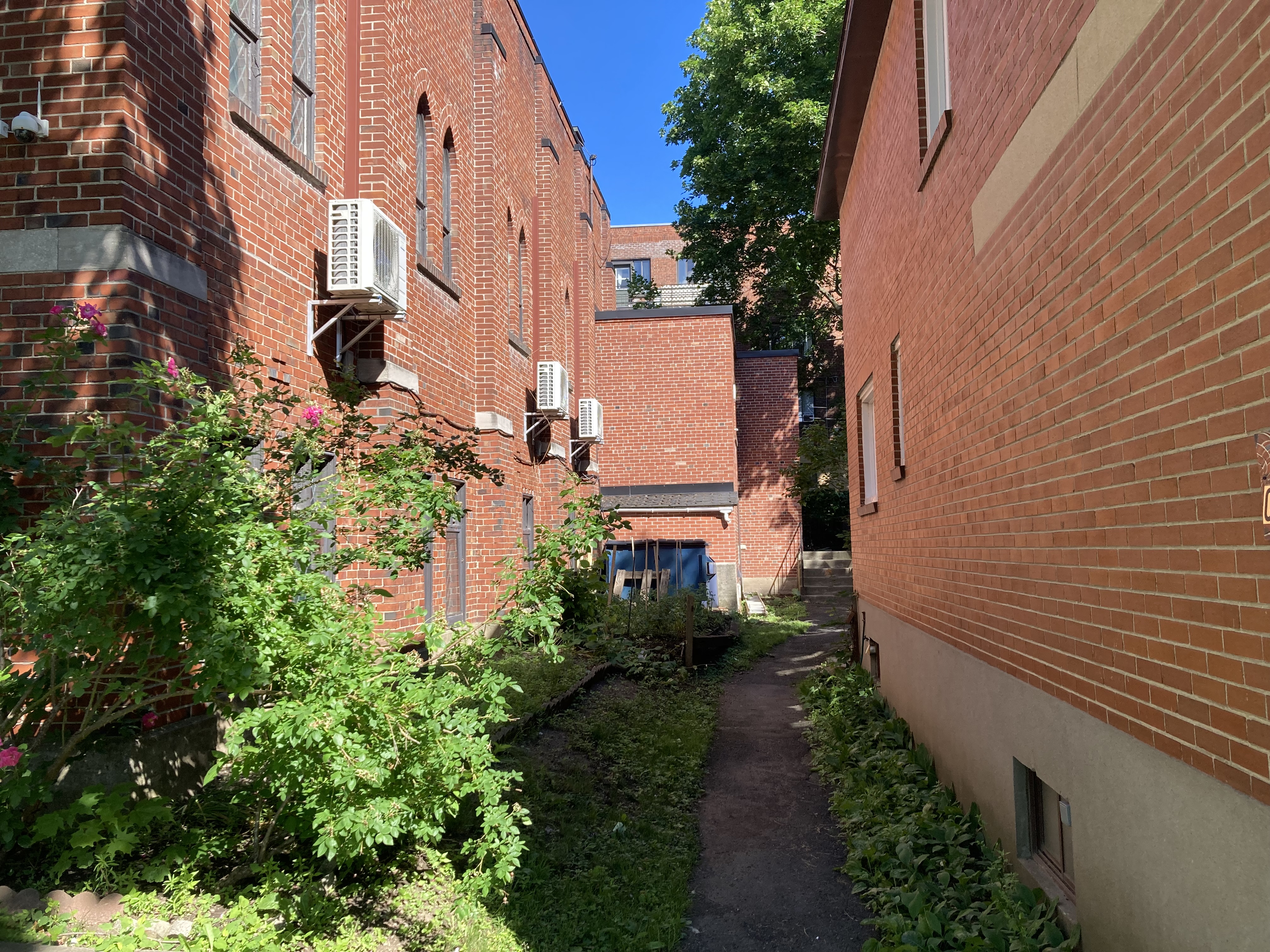
I've driven by St. Paul`s Anglican Church many times, it is located at 3970 Cote Ste-Catherine Road almost directly across the street from the Jewish General Hospital. It is a simple building, constructed in 1935. There are two other Anglican churches that I am reminded of by St. Paul's, all three churches are small buildings compared to other Anglican churches on the Island of Montreal: one is St. Stephen's Church in Lachine, it is the oldest Anglican Church on the Island; the other church, formerly Anglican, belongs to the Romanian Orthodox Church and is located on Upper Lachine Road. There is a wealth of history associated with all three of these churches. Here are a few photographs of St. Paul's Anglican Church taken at the end of June 2024; it is a brave little church. 


Tuesday, March 19, 2024

St. Matthew`s Anglican Church

Here are photographs of St. Matthew's Anglican Church that I attended as a child. (Located on Macdonald Avenue, just off Cote St. Luc Road in Montreal.) Everyone seems to have a complaint about something these days, especially religion,  but I have no complaints about St. Matthew's or about the Anglican Church of Canada; I was always treated with kindness and respect. Reverend Canon Stanley Andrews officiated at my father's funeral when I was a child and he gave my mother good advice about financial matters: banking rules at the time would have deprived her of whatever money our family had because bank accounts were in the husband's name. Reverend Andrew's advice was practical and helpful, it was to take whatever money we had out of the bank accounts before the bank froze the accounts.  In those days, the 1950s, Anglican churches in Montreal had dances for young people at the church. The last time I attended a service here, it was Christmas in 2007, the congregation had dwindled to about a dozen people. I didn't know at the time that it was the last service I would attend there. 

Photographs taken around 1957, outside the side door which is also pictured in a later photograph; other photos taken from the late 1990s to around 2017.


This view was lost when a condo building was constructed in the foreground;
the condobuilding is under construction here


Above, around 2005

My mother, recently widowed.

My mother and I. 


Above, around 1957-1958


17 March 2017


22 July 2015


The Montreal Gazette, 14 May 2011


Friday, October 7, 2011

F.R. Scott memorial plaque unveiling


The F.R. Scott Memorial, 12 October, 2011, at St. James the Apostle Church, Montreal


A commemorative plaque for F.R. Scott will be unveiled on October 12 at St. James the Apostle church here in Montreal. Scott was a constitutional lawyer, a McGill professor of law, and an important Canadian modernist poet; however, poetry was his first love. He states, “Everything in my life that I did was done with a feeling of making poetry.”

Below is an excerpt from an interview with F.R. Scott published in the Quill & Quire in July 1982. Scott’s answers here deal with the Canadian Constitution, Canada-Quebec relations, and the big multi-national corporations; his answers are prescient and insightful in light of today’s world:

Q&Q: Is the Canadian Charter of Rights and Freedoms entrenched in the new Constitution the one you would have wanted?

Scott: The Charter of Rights is certainly not the one I wanted. It was put together in such a hurried fashion. All these power boys running around in smoke-filled rooms. There are many things in it that will cause us tremendous headaches. Of course, I have been in favour of an entrenched bill of rights written into the old Constitution, it was understood that certain laws affecting freedom of speech, freedom of assembly or freedom of religion could not be tampered with beyond the surveillance of the court — on any condition. Now, although it is entrenched really it is only partially entrenched because there’s the clause allowing a province to opt out. Quebec wants to do this.

Q&Q: Do you think the current form of Quebec nationalism is a progressive force?

Scott: I think the Parti Québecois’ position of independence is reactionary. Furthermore, I think it is immoral. It will make everybody worse off. There’s no absolute right to independence. You’ve got to see what harm it will do. To take a functioning federal system and split it into pieces is doing so much harm all around and about that I say it is immoral. Quebec has not been so badly treated. Separatism is just satisfying an amour impropre.

Q&Q: Is it too late to bring Quebec back into the fold?

Scott: Quebec is more subconsciously in the fold than we think. You know, I was a great defender of Quebec’s rights when it came to compulsory conscription. That made me a total isolationist when the war broke out and got me into more trouble than being a socialist. But it has always been my hope and faith that Quebec will come back. It will take a good deal of common sense, which I’ve always felt French-speaking Quebeckers have, and which their English-speaking counterparts increasingly show.

Q&Q: When you entitled your brief to the Royal Commission on Dominion-Provincial Relations, “Canada — One or Nine”, were you questioning the ability of Canadians to grasp the potential of their country and does this still worry you?

Scott: This problem is as real to me today as it was in 1938. The spirit of commercialism, the disregard of the community, this attitude is so powerful and has as its most active defenders the big corporations. Only a strong federal state can stand up to these gigantic corporations though even it seems to have a hard time doing so. But at least a strong federal state can evoke a certain national will that says this is our place, these are our resources. To hell with the continental arrangement where the corporations will take 90% and the country will be left with 10%. We must say, we’re going to come into our own slowly. And if we had nothing but little individual nation states, little feudal forts running Canada, we’d be completely swallowed. I think I was ahead of my time in saying we must strengthen the federal system.