T.L. Morrisey

Showing posts with label history. Show all posts

Tuesday, July 7, 2026

The Mind Mappers, Friendship, Betrayal and the Obsessive Quest to Chart the Brain, by Eric Andrew-Gee


This review was published in Public Reverie on 5 July 2026.

-0-


The Mind Mappers: Friendship, Betrayal and the Obsessive Quest to Chart the Brain
Eric Andrew-Gee   
Random House Canada
2025, Toronto, Canada
ISBN: 978-1-03-900806-9

Review by Stephen Morrissey


Some books are read for entertainment. For example, detective novels. Some books are read because we want to learn something new about politics, lives of famous people, beekeeping, or how to play chess. However, the books I enjoy the most are those that we read and learn something about ourselves. Such books inspire us to go more deeply into ourselves, and help us to see things in a new way. This was my experience with Eric Andrew-Gee’s The Mind Mappers: Friendship, Betrayal and the Obsessive Quest to Chart the Brain (2025). I immediately liked this book; I liked Andrew-Gee’s writing, I appreciated his thorough research, his occasional references to literature; and his knowledge of the English-speaking community in Montréal, our history, and our accomplishments. These include the founding of the Montreal Neurological Institute, locally known as The Neuro, and still pre-eminent among neurological hospitals. 

Andrew-Gee’s book is about the co-founders of The Neuro: Dr. Wilder Penfield and Dr. William Cone. They began as friends and close collaborators in the 1920s, working together at New York City’s Presbyterian Hospital. In 1927, when Penfield was offered the job of chief brain surgeon at Montréal’s prestigious Royal Victoria Hospital, he set two conditions: The first was that the hospital would provide him with research as well as surgical facilities. The second was that Cone, his “undivorceable colleague,” as he called him, would come too. In 1934, with the help of a 1.2 million dollar grant from the Rockefeller Foundation to McGill University, Penfield and Cone co-founded The Montreal Neurological Institute. This pioneering institution brought together the subdisciplines of neurology, neurosurgery, and neuropathology. 

According to Andrew-Gee, Dr. Cone was a private person, not given to talking about himself. He was self-effacing, and he preferred to stay in the shadow of his oldest friend and colleague, Dr. Penfield, who was nick-named “The Chief” when he became director of The Neuro, where Cone was affectionately known as “The Boss.” Dr. Penfield remains a fairly flat, one dimensional character throughout most of Mind Mappers. Although he was the chief brain surgeon at Royal Victoria Hospital, Penfield handed off many surgeries to Cone while pursuing the funding that allowed him to steer The Neuro. His driving motive was ambition. Penfield does not gain complexity until the book’s “Epilogue: Through a Glass Darkly.” Here, we read of how Penfield grew away from neuroscience in his later years. After retirement, he wrote novels, his autobiography, and advocated for causes that were important for him.  

With Penfield’s announcement in the late 1950s that he would retire from directing The Neuro, it was assumed that Dr. Cone would be promoted to that position. According to Andrew-Gee, this should have been the pinnacle of Dr. Cone’s career: a confirmation of Penfield’s belief in him and his confidence in Cone’s ability to lead. Yet he was passed over by Penfield. Cone wasn’t even on the short list of candidates. I emphasize this to show how deeply betrayed Cone must have felt by the way Penfield treated him. Mind Mappers convincingly argues that it was not only betrayal that Cone felt, it was also humiliation at being passed over for a position that most of his colleagues felt he was next in line for and rightfully deserved. Dr. Cone committed suicide in his office at The Neuro on 4 May 1959.

In personality and temperament Dr. Cone and Dr. Penfield were very different people. Andrew-Gee researches and depicts Cone’s unhappy childhood: a time of illness for him compounded by the deaths of his father and grandfather. Later, Cone had a profoundly unhappy and childless marriage, in part because he devoted so much of his time to Penfield and their patients. Now, there was this stunning betrayal by his oldest friend and colleague. Dr. Cone must have wondered if his friendship with Penfield had ever really existed, or had he deceived himself all of these years. By contrast, Penfield’s mother doted on him and he was much loved by her and by his wife, their children, and grandchildren. Penfield was an extrovert whose ambition after founding The Neuro shifted to winning a Nobel Prize for his discoveries in neuroscience. He never did win one. Cone comes across as psychologically complex, while Penfield seems lacking in complexity. Andrew-Gee’s book prompted my realization that Penfield’s image of respectability was flawless except for one major flaw–his betrayal of his best friend.

After visiting The Neuro in April 2026, I remembered that I had, at home, a copy of Wilder Penfield’s Man and his Family. In fact, I’d had it ever since it was first published in 1967. A few days later, I read Penfield’s book. Its theme is the importance of family in society. Penfield argues that for children, the foundation of family life is essential to a healthy adult life. The book is worth reading for its ideas, but it is not well written. Man and his Family also raises questions about how Penfield might have judged Cone for the lack of father figures in his own childhood. After retiring from The Neuro, Penfield served as President of the Vanier Institute of the Family. He was one of the last people to meet with former Governor General Georges Vanier on the day before Vanier died.

My first time visiting The Neuro was in October 1969 to visit my stepfather, who had brain tumor surgery there in the late 1950s; he seemed to have recovered and married my mother several years after this surgery. He needed surgery again in 1966, for a second tumor removal. Dr. Theodore Rasmussen was then The Neuro’s director; he was also my stepfather’s surgeon, and successor to Dr. Penfield. This second surgery was unsuccessful. For the next three years, my stepfather lived alternately at home for a few weeks, then in residences (one in Rawdon, Québec). His physical and mental decline continued, and he returned to The Neuro a final time in fall 1969. I don’t know how my mother survived those years, my stepfather did not survive. I should add that today, the post-operative mortality rate for brain tumor surgery is about 35%. It was much lower sixty years ago.

I remember my visit to The Neuro in late October 1969. My stepfather was in a bed directly across from the door of his hospital room, one shared with perhaps three or four other patients. I was nineteen years old and had just started university. I remember trying consciously to think of something reassuring and kind to say to my stepfather. I said something before leaving. And as someone who remembers so much, who has made memory the basis of much of my writing, I just can’t remember what I said to him. I do remember the morning, a few days later, that my mother received a phone call from The Neuro, telling her that he had died; I was lying in bed upstairs and I could hear the phone ring and my mother answer and speak to whoever was calling. I knew intuitively what the call was about. It was more relief that we felt than anything else; it was the end of my stepfather’s suffering. But relief is short-lived and grief has a long afterlife.

Now, here is an interesting coincidence regarding my stepfather. Dr. Penfield’s book, Man and His Family, was made up of his Josiah Wood Lectures on the family, lectures given at Mount Allison University in Sackville, New Brunswick. My copy of this book was “presented to us under the terms of the Josiah Wood lectureship.” The coincidence is that Josiah Wood was my stepfather’s grandfather. Josiah Wood’s daughter, Dora Beatrice Wood, married Mark Edgar Nichols, who was a founder of the Canadian Press and editor of newspapers in Montréal, Winnipeg, and Vancouver. They had three sons, Mark, Charles, and my stepfather Graham Nichols.

I admire Dr. Penfield and Dr. Cone. Their personal and professional story, one that is not commonly known, as it is described by Eric Andrew-Gee, only increases my admiration and appreciation for these two men and their advances in neuroscience. Their most enduring legacy, other than important innovative surgical techniques and the significant mapping of the areas of the brain, is the founding of the Montreal Neurological Institute. The Neuro is an important place for neurological research and patient care, it is a place full of dedicated doctors and nurses. But there is also a human dimension to specialized medicine. Mr. Andrew-Gee’s book explores this aspect of The Neuro through the relationship of its co-founders; he does so with superb research and poignant insights. Andrew-Gee writes: “Both Cone and Penfield felt their lives were failures in different ways, and it is true that in some areas they fell short. The bitterest failure of all was the most meaningful: Cone and Penfield mapped the brain but lost each other.”

Andrew-Gee identifies the enduring success of their long collaboration: “As the medical historian Yan Prkachin has argued, the ‘interdisciplinary environment created within the walls of the Montreal Neurological Institute constitutes the key site for the foundation of modern neuroscience.'”

And  Andrew-Gee concludes by writing, “Cone and Penfield may not have perfected neurosurgery or discovered the seat of the soul. But to anyone who has tried since—or tried to fathom the many other mysteries of the universe in our heads—they were not failures at all.” 

Eric Andrew-Gee’s The Mind Mappers: Friendship, Betrayal and the Obsessive Quest to Chart the Brain takes us deeply into the relationship of Dr. Wilder Penfield and Dr. William Cone and the founding of the Montreal Neurological Institute;  it was an historical period that includes tragedy, betrayal, love, selfless commitment, and the fragility of human relationships.


Monday, April 6, 2026

Hubert Darrell and Darrell Morrisey, the Two Darrells


Anyone following my work knows of my interest in the "forgotten" Beaver Hall Group artist Darrell Morrisey. I thought that I had written what I wanted to say about Darrell Morrisey and then I read Adam Shoalts's Vanished Beyond the Map: The Mystery of Lost Explorer Hubert Darrell and I
realized that a little more needed to be said on Darrell Morrisey. Hubert Darrell, who explored and mapped parts of Canada's far north, is the son of Charles Darrell after whom, coincidentally, Darrell Morrisey was named. In 1890 Hubert Darrell moved to Birtle, Manitoba and several years later he began his exploration and mapping of Canada's far north. Darrell Morrisey was an artist and member of the prestigious Beaver Hall Group of artists. The two Darrells never met and, tragically, they both died young, but they lived true to their inner calling, one that was far removed from the expectations of their families and social class. Here is the essay, THE TWO DARRELLS, HUBERT DARRELL AND DARRELL MORRISEY.

Friday, December 16, 2022

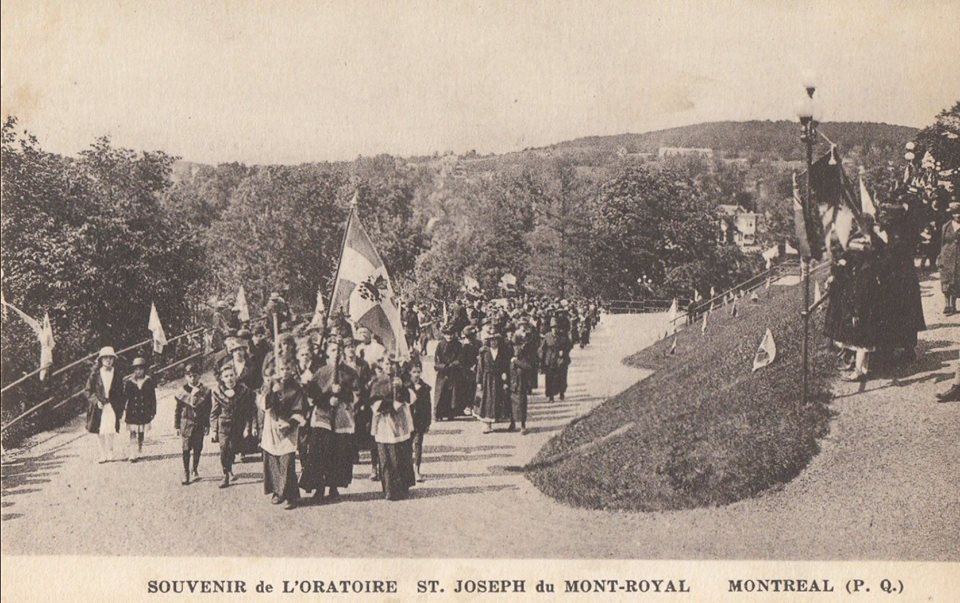
Historical photographs of St. Joseph's Oratory


Work on St. Joseph's Oratory; early 1900s

The first chapel at St. Joseph's Oratory


1950s

Climbing the stairs at St. Joseph's Oratory

Photo taken 1938

Thursday, September 10, 2020

St. Stephen's Anglican Church in Lachine, Quebec

I used to visit Lachine, Quebec, fairly regularly. It's only fifteen minutes from where I live in Montreal but it always feels like I am on holiday when there. You can walk along the Lachine canal, visit different museums, eat at some terrific restaurants, go fishing at the lighthouse, walk along Lac St-Louis... on one of these walks I came across St. Stephen's Anglican Church. This is the oldest Anglican church on the Island of Montreal; founded in 1822, construction of the church was completed in 1831. The church is located at 25 12th Avenue in Lachine, behind the Couvent des Soeurs Ste-Anne, which I believe is now a college. I made this video in the spring of 2013.


Thursday, October 19, 2017

Poetry as place, history, soul

I wrote these notes before a reading at the Visual Arts Center in Westmount, QC, on 17 October 2017:

Poets aren't nomads, we all come from somewhere; and this "somewhere" is our psychic center, our home, the place we identify with, the place where we have a history. Personally, place is very important to me—I think it is essential in poetry—and I identify with Montreal, the home of my family since we moved here 180 years ago. Everywhere I go in this city I find something that expresses my soul, my inner being, the place of my ancestors and my family. That is why I say I am a Montreal poet, for nowhere else I have been is home as much as Montreal is home. So, not only is poetry an expression of location but it is also a place of history, of what happened in the past, of names, places, dates, events; that is to say it is a place of psyche, of the soul.


Lane behind Girouard Avenue.


Lane behind Girouard Avenue.


Lane behind Girouard Avenue.


Looking towards Girouard Park, one street west of Girouard.


A few years ago when they renovated 2226 Girouard, my grandmother's home from 1925 to 1965, they didn't put in a new door (as seen above) that leads to the basement. 


Looking up at the back porch of my grandmother's flat on Girouard. 


Monday, March 7, 2011

Biography of Father Martin Callaghan


A drawing of Father Martin Callaghan when young


Father Martin Callaghan in 1903


Photo montage of the pastors at St. Patrick's Church, Montreal;
Fr. Martin Callaghan, top middle

Father Martin Callaghan


Father Martin Callaghan was born on 20 November 1846 in Montreal. He attended the Petit Seminaire du College de Montreal (1860-1868) and he studied at the Grand Seminaire from 1869-1872. He was ordained a priest in 1872 and the following year he asked his Bishop to be allowed to enter the Sulpician Order for further training. The Sulpicians are a "secular order", dedicated to training priests, but are not allowed to recruit priests to their order. Sulpician priests are referred to as "The Gentlemen of St. Sulpice" and are addressed as 'Monsieur'. Father Martin served as an auxiliary professor at the College de Montreal from 1872-1874. He served as vicar at St. Patrick's Church from 1875-1902; from 1902-1908 he was the pastor at St. Patrick's. He resigned from St. Patrick's in 1908 after thirty-five years service and was designated confessor of the Freres des Ecoles chretiennes. He also served at Notre Dame Church from 1908 to 1915 where he occasionally worked as a minister. Father Martin was dedicated to helping the poor and the working class, the class from which he came. He was also renowned for converting people to the Catholic faith; a church biography of Father Martin states, "par le nombre des convertis estimes par les statistiques les plus moderees a 3,000," which includes "protestants, juifs, Negres, Chinois".

Here is a short booklet containing the text of Fr. Martin`s sermon, "The shamrock, or, Ireland's threefold love"; a "beautiful sermon" preached on St. Patrick's day in St. Patrick's Church, Montreal, March 17th, 1877.

In 1915, upon returning to Montreal from Baltimore where he assisted at a funeral for another priest, Father Martin fell ill; this soon developed into congested lungs. Father Martin died on 10 June 1915 in his sixty-ninth year. His brother, Father Luke Callaghan, sang the mass at Father Martin's funeral. One booklet describes the funeral: "A large cortege of mourners accompanied his remains to their last resting place beneath the chapel of the Grand Seminary on Sherbrooke Street."

Father Martin was also an authority Canadian on folklore and for a number of years he was the owner of the Fleming Windmill, an historical landmark located in Ville LaSalle.

His obituary, published in the Montreal Star of 11 June 1915, states that, 'Father Martin,' as he was affectionately known to many, 'was a true Irishman in warmth of heart and breadth of sympathy. His gifts to charitable movements were countless, and many of his benefactions were known only to himself. The poor and needy always found him a ready listener to the story of their troubles.'

Here is an article on Fr. Martin Callaghan from 1915, I have just added the original image of this newspaper article below:


LATE FATHER CALLAGHAN

BELOVED PRIEST,

REV. M. CALLAGHAN

HAS PASSED AWAY


Formerly of St. Patrick’s

Well Known Throughout Province


Good Violinist

And Wrote Music


Authority on Canadian

Folklore—Gave Much

to Charity

The Reverend Martin Callaghan, former…. and [one of the] best known English speaking priests in the Province of Quebec, died last evening at the Hotel Dieu, after an illness of two weeks. He was sixty-nine years old.

Father Callaghan, whose career in the priesthood was long and useful, was born in Montreal, November 1846. He was educated, under the Rev. Father Mayer and the Sulpicians on Sherbrooke Street where after completing his studies he was professor of English for one year, having among his pupils Archbishop Bruchesi of Montreal and Archbishop Langevin of St. Boniface, and many men now prominent in the public life of this Province.


ST MARY’S CURATE

Father Callaghan studied theology under Rev. Fathers Levigne and Colin (?), and was ordained priest by the late Bishop Bourget. He was admitted a member of the Sulpician community in Paris, and began his ministry in Montreal as a curate of St. Mary’s under Father Campion. After one year at St. Mary’s he was appointed to St. Patrick’s under Father Dowd, and afterwards Father Quinlivan, succeeding the latter as pastor of St. Patrick’s. He served for a year under the Sulpician regime under Archbishop Bruchesi.

In December, 1907, after four years service as pastor of St. Patrick’s, Father … resigned to be…pastor…

Father Callaghan was well known as a musician. He was a violin pupil of Oscar Martel, violinist to the late King of Belgium. He was the author of many musical compositions, a number of which were rendered for the benefit of Montreal charities at various times. A deep student of Canadian folklore, his lectures on this subject had been enjoyed by thousands. “Father Martin,” as he was affectionately known to many, was a true Irishman in warmth of heart and breadth of sympathy. His gifts to charitable movements were countless, and many of his benefactions were known only to himself. The poor and needy always found him a ready listener to the story of their troubles.


GAVE AWAY LAND

A year ago he gave a piece of land in the parish of Lachine, which he had purchased some time before as a site for an English-Catholic college, to the Presentation Brothers, for a novitiate. The land was valued at $50,000. Later he gave the same community a site at Longueuil.

 As a missionary priest Father Callaghan met with great success, his converts being numbered by thousands. He took special interest in work among the Chinese of Montreal. In collaboration with the Rev. Father Montanard, now serving with the French army, he prepared a Chinese-English catechism.

 His brother, the Rev. Luke Callaghan, parish priest of St. Michael’s, was with him at the time of his death, as were his sister Mrs. Farrel, of Lachine, and Rev. Sister Morrissy, and assistants of the parish of Notre Dame. 


Fleming Windmill, Montreal, 1900's


Farmhouse and Fleming windmill, Lasalle, near Montreal, QC, about 1870

In 1815, William Fleming, a Scottish immigrant, built a stone house and a wooden windmill on his property in Lower-Lachine, facing Lac Saint-Louis, near Chemin du Roi (present-day LaSalle Blvd), which was a major thoroughfare and transportation route at the time. He ground barley and rice for local farmers who sold to the Montreal breweries. In 1816, Fleming decided to grind wheat. But this was in direct conflict with the Seigneurial rights of the Sulpician Seminary in Montreal, who had the monopoly on all flour-producing mills since 1663, requiring farmers to have their wheat ground by Sulpician mills for a fee. The Seminary, insisting on their rights, ordered Fleming’s mill to be demolished. Fleming’s lawyers replied that the Seminary had no legal power to rule in Canada. Their status was given by the Séminaire de Saint-Sulpice de Paris, which had no authority in Canada. In 1822,the King’s Bench ruled in favour of the Seminary and ordered non-regulation mills to be demolished. Fleming appealed the decision. Three years later, the eight judges of the Court of Appeal were unable to reach a majority decision, which constituted a victory for Fleming, since, in the absence of a decision, the Montreal Seminary could not force him to demolish his mill. William Fleming took advantage of the victory and decided to rebuild the mill in stone in 1827. He signed a building contract with the mason, William Morrison to build the stone windmill that stands to this very day. From 1827 to the 1880s the ownership and operation of the mill remained within the Fleming family. When William Fleming died in 1860, his son John took over operation of the mill. When activities ceased in the 1880s, the mill’s condition rapidly deteriorated. In 1892, the mill lost two of its blades and the rotating mechanism collapsed. At the turn of the century, the roof and the mechanism had fallen inside the building. After John Fleming’s death, his widow, Isabella Wylie bequeathed the property to Reverend Martin Callaghan, who later transferred the property to Reverend E.P. Curtin. In 1914, Curtin donated the mill to a religious community known as the Presentation Brothers of Ireland. In 1928, The Wellcome Foundation acquired the mill and the surrounding land from the Presentation Brothers of Ireland with the intention of establishing a pharmaceutical company in the area. 

Around 1930, the mill and its internal mechanism were restored. As a result of the company’s efforts, the mill was saved from total destruction. In 1947, the City of LaSalle acquired the site from Burroughs Wellcome. Municipal authorities were more concerned about residential and industrial development than about heritage protection, and many old houses were demolished to make room for more modern buildings. In 1976, the Cavelier-de-LaSalle Historical Society convinced the city to apply to the Ministère des Affaires Culturelles du Québec, in order to have the mill recognized an official heritage site. They felt that their application was justified even if the millstones and the interior mechanism had disappeared without a trace. In 1982, the city of LaSalle adopted the mill as its official emblem and continued to put pressure on the Quebec government to accelerate the processing of the heritage recognition application. Finally, in 1983, the mill was officially classified as an archaeological heritage site by the Ministère des Affaires Culturelles du Québec. After being restored in 1990, it became a historical interpretation centre, open to the public every weekend during the summer. The Fleming Mill is the only windmill of Anglo-Saxon design with a device for turning its sails windward, still standing in the Province of Quebec.


Note: Edited 18 October 2025. This original 1915 newspaper article regarding Fr. Martin's death is below. 


Revised: 13 November 2025