Saturday, May 16, 2026
At The Neuro, 30 April 2026
Friday, May 8, 2026
John McAuley, poet, some photos
| John McAuley and Claudia Lapp, at Bleu Met Literary Festival, April 2018 |
| John McAuley reading at Rare Books and Special Collections, McGill University, 26 April 2018 |
| Waiting to read at Rare Books and Special Collections, 26 April 2018 from left to right, Endre Farkas, Tom Konvyes, Claudia Lapp, Stephen Morrissey |
| John McAuley, sound check before reading at Rare Books and Special Collections, 26 April 2018 |
| John McAuley and Tom Konyves, 26 April 2018 |
![]() |
| John McAuley reading at the Yellow Door, May 2013 |
Friday, July 18, 2025
Meetings with RR Skinner
![]() |
| Photo of RR Skinner provided by Patricia Proenza in 1988 |
Hark, hark! the dogs do bark,
Beggars are coming to town.
Some in rags, some in jags,
And some in velvet gowns.-- Quoted by RR Skinner
What follows (in the following posts) are the events and narrative of meeting RR Skinner; our first meeting was in 1974, the last meeting was in 1986. This is taken from notes I made after these meetings; they were marathon sessions of talking with (mostly listening to) Reg, including what he told me about himself, his life, his family, and his observations on life. When I told Reg in 1985 that I would like to write about him he gave me a thick manila envelope containing copies of his various essays written over a thirty year period, I returned these papers to him later. The manuscript that I wrote became "Meetings with RR", it’s 125 pages of double-spaced text; it is unpublished and probably will never be published.
RR Skinner was born on 03 July 1909; he died at Bognor Regis on 31 December 1999 (these dates may not be accurate). From age eight to eleven he did not attend school because of frail health, he had a tubercular bowel and spent these three years in hospital or convalescing at home; this was a time of relative isolation and solitude. After returning to school he found that he couldn't pronounce certain words because of a stammer, but he overcame this through an effort of will. He was the seventh of fifteen children, plus two adopted children. Reg's mother, who ran and ministered her own spiritualist church in Bethnal Green, London, believed that her son would be the next world-teacher and she raised him for that position (this sounds terribly inflated today but it was also the aim of the Theosophical Society to find the next messiah or world teacher, a Buddha, and the person they eventually found was Jiddu Krishnamurti who eventually renounced this idea). In a letter to a friend RR's mother said that the child she was carrying, the future RR Skinner, would be the next messiah. RR told me that his ability to vet people was part of his training at his mother's church, it was his training to be a psychic and spiritual teacher. Many years ago I attended a few spiritualist meetings, these aren't seances but church services, sometimes these services were held at rented spaces in office buildings, and once at the Unitarian Church of the Messiah or, at other times, the Spiritual Science Fellowship, both located in Montreal; there is usually a non-denominational religious service, including hymns, followed by the medium addressing the congregation and communicating messages allegedly from the departed to their family members. I believe RR's mother, Elizabeth Mary Eagle Skinner, was the main influence of his life.
Thursday, August 29, 2024
The Quebec government is destroying our universities
![]() |
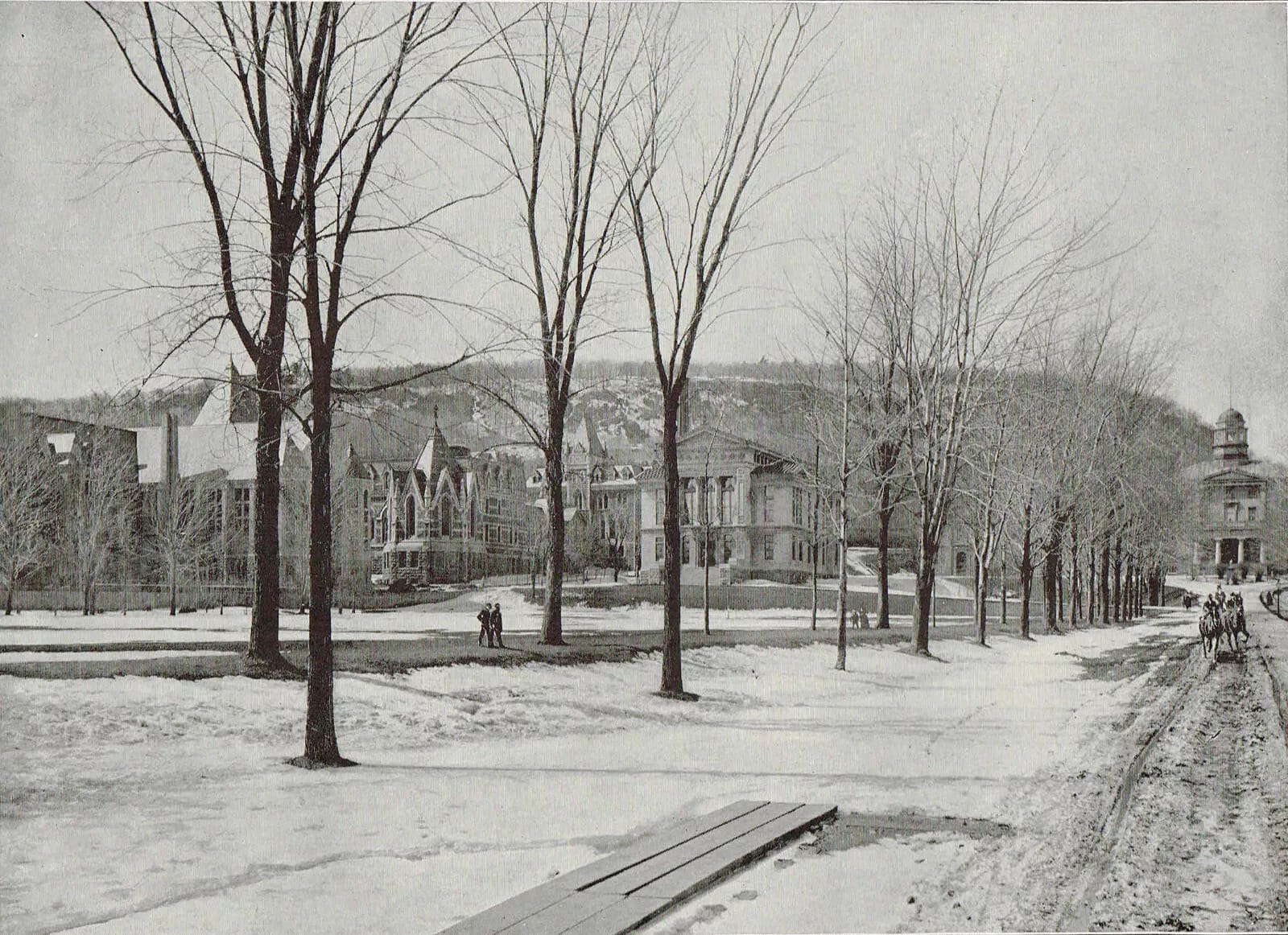
| The campus at McGill University, Montreal, 1906 |
One day last fall, in 2023, Premier Legault of Quebec walked out of his Montreal office, which is across the street from the Roddick Gates entrance to McGill University, and decided, as he described it at the time, that he could hear too much English being spoken and, he claimed, this was to the detriment of the French language, and therefore it had to end. And who did he blame for this linguistic pollution? He blamed out-of-province and foreign students although he probably would have liked to have included all English-speaking Quebecers. This was the beginning of the Quebec government's attempt to destroy English language university education in Montreal and Quebec.
Here is the scenario we were presented with by Premier Legault justifying cutting provincial funding and doubling tuition for out-of-province students at the three English-language universities in Quebec, Bishops University, Concordia University, and McGill University. The money from this drop in funding would go to French-language universities; the three English-language universities would now subsidize the French universities; however, Bishops was later exempted from this attack on English universities. Legault made the situation even worse; out-of-province students would now have to pay a higher tuition fee than they were currently paying (it was doubled but a few months later McGill and Concordia announced they would will subsidize students affected by this) and these students would also have to take French language courses that would add a semester to their studies, courses that are possibly beyond the ability of most Francophone students. Almost immediately applications to study at McGill and Concordia began to fall, the three English-language universities are now subsidizing French-language universities. As well, Moody's downgraded the credit rating of both universities based on Legault's pronouncement.
While Premier Legault blamed foreign students for the dystopian crime of speaking English in public, what he was also attacking was the very existence of McGill University and Concordia University and English-language higher education in Quebec. Here is a hypothetical (but equivalent) situation to what is happening to McGill University, it would be if the premier of British Columbia visited the Vancouver UBC campus and, apparently, just on a whim, announced that he was cutting funding for the University of British Columbia because the student body is more than half Canadian born Asians and 25% of the student body are foreign students; all of Canada would be appalled by this, the situation would be denounced, Federal politicians would be shocked and demand redress; Justin Trudeau would be apoplectic. What we have in Quebec is a racist attack on the English language community, an attack on both McGill and Concordia; it is an attack on our community's history and presence in Quebec. It is an attack on higher education. What Legault wants is a white French speaking province of Quebec that is ethnocentric and isolated from the outside world; if you aren't white and pure laine, then you are not a part of the Quebec nation, they want you gone. But since this atrocity is happening in Quebec, and it is against our English-language community, it is greeted with silence and even applause by our Federal politicians. From them we hear absolutely nothing, it is total silence, they want the French vote in Quebec no matter that it is destroying our community.
The wilful destruction of an institution of excellence, based on hate and hubris, is evil.
Addenda: enrollment is declining at Concordia University due to Legault's defunding English-language universities in Montreal. 29 August 2024.
Read this re McGill's "sustained excellence", https://reporter.mcgill.ca/sustained-excellence-mcgill-tops-macleans-rankings-again/
Tuesday, August 27, 2024
The Parasitic Mind by Gad Saad
I highly recommend Gad Saad's The Parasitic Mind, How Infectious Ideas Are Killing Common Sense (Regnery Publishing, Washington, DC, 2020). It’s an excellent book that deals with revealing truth and common sense in a world corrupted by a progressive woke ideology. Towards the end of the book Professor Saad, who teaches at Concordia University in Montreal, writes,
Everybody has a voice. Activate your sense of personal responsibility. You have agency. Participate. Do not be a bystander as truth, reason, and logic call out for your help. Do not subcontract your voice to others. Do not self-censor. You and your children have a stake in the outcome of this battle, so don't be afraid to speak up. Do not succumb to the Tragedy of the Commons (as popularized by the ecologist Garrett Hardin in 1968), in this case a tragedy of collective inaction. (p. 172)
Wednesday, July 17, 2024
The promise of the 15 Minute City

I'll move myself and my family aside
If we happen to be left half-alive
I'll get all my papers and smile at the sky
For I know that the hypnotized never lie--The Who, “Won't Get Fooled Again"
Here is a definition of the 15 Minute city, from a Wikipedia article; it is
an urban planning concept in which most daily necessities and services, such as work, shopping, education, healthcare, and leisure can be easily reached by a 15-minute walk, bike ride, or public transit ride from any point in the city.[4] This approach aims to reduce car dependency, promote healthy and sustainable living, and improve wellbeing and quality of life for city dwellers.
The 15 minute city sounds lovely, we can all live in small communities and have all the amenities of life within walking distance, no cars, no traffic, no hustle and bustle, no hassle! Only pollution free air as we ride our bicycles waving to each other, to the fellow walking on the sidewalk by a florist shop where he stops to converse with the shop owner and buy a few roses for his partner. It is all happiness and community living! And if you suggest the opposite, that the 15 Minute City is a nightmare waiting to happen, a way to control the movement of the population, you are a right wing conspiracy nut. But that is exactly where we know the 15 Minute City is leading, we all know it; for instance, a CBC article published on 26 June 2024 reads "Edmonton promises residents 'freedom of movement' to calm concerns around 15-minute cities".
Urban planners have not solved the problem of homelessness so why would we believe they can provide the utopia of a 15 minute city? We saw how major cities in China, during the covid episode, isolated parts of cities with walls and guards, the movement of inhabitants were strictly controlled, some were kept isolated in their apartments and were supplied with groceries only out of the kindness of relatives and friends, some went hungry. Some people managed to escape and buy groceries outside of the area of their very real imprisonment. The 15 Minute City is ideal for times of pandemics, it is designed for limiting people's freedom of movement, and limiting information being communicated from one group to another. It is also a time for the abrogation of freedom of speech.
What we now have in all of our cities — homelessness, unemployment, and food insecurity —won’t be solved by the 15 minute city; there is no quick fix for these social problems and the 15 Minute City won’t change this, it will only make it easier to control people. It occurs to me that some 15 minute cities will be homeless encampments, isolated to protect the inhabitants of other 15 minute cities from poor people, drug addicts, and people labelled undesirable by what remains of the middle class. We already have this, it is part of urban living. Problems that aren't solved now won't be suddenly solved by the 15 minute city; they will only continue and get worse. This is common sense.
In different ways our society is disintegrating, what we had is a thing of the past and what we are left with is the detritus of the past. For instance, in Canada we live in fear of losing our family doctors, the family doctor is increasingly a thing of the past as is the middle class and the aspirations of the middle class: too many people can no longer afford to buy a house in which to raise their family, some can't afford to rent an apartment; a growing number of people are unemployed and unhoused; food banks can't keep up with the growing number of people using their services; there are a growing number of people who are addicted to fentanyl and other drugs. The 15 minute city is a fairly shallow diversion from these growing problems; the old society has collapsed and the new society is one defined by globalization and progressive ideology. We are deluged with immigrants, they are cheap labour, just when citizens can't find work and are criticized for not taking low paying jobs; in the 1980s and 1990s we exported our jobs to the Third World, now we are importing the Third World to work here. Under the present regime our population has exploded to 41M people; the floodgates for immigration are open and yet our society can't house, employ, or feed our current population.
A study at McGill University (from McGill’s Institutional Communications, 21 June 2024) is redefining the 15 Minute City,
Published in the Journal of Urban Mobility, the study examines travel behaviour and geospatial data from Montreal and finds, contrary to expectations, that only a small fraction of households can feasibly meet all their daily needs within 15 minutes of home using active transportation.
"Our study challenges the notion of a one-size-fits-all approach to urban planning,” says Ahmed El-Geneidy, Professor at McGill University’s School of Urban Planning. “While the 15-minute city concept has gained momentum globally, our research emphasizes the importance of locally relevant strategies that consider the diverse needs and realities of communities."
The research suggests a 30-minute model may be more realistic for North American cities, provided appropriate urban-design changes are made. Furthermore, the researchers underscore the need for urban-sustainability strategies that address not only travel behaviours but also neighborhood characteristics, household dynamics and social equity concerns.
If the 15 minute city becomes a 30 minute city, and then the 30 minute city becomes the 60 minute city, then what we have is what we already have, a “city” with the same problems that we are now facing. The 15 minute city is about social control and keeping citizens isolated; don’t be fooled again, it is a false utopia as are all utopias, nothing else.
Addendum: in this article published on 27 August 2024 citizens of Brandon, Manitoba, fear the 15 minute city will be imposed on them.
Wednesday, February 7, 2024
"Laurentian Shield" by F. R. Scott
![]() |
| Events and Signals, F.R. Scott, Ryerson Press, 1954 |
Hidden in wonder and snow, or sudden with summer,
This land stares at the sun in a huge silence
Endlessly repeating something we cannot hear.
Inarticulate, arctic,
Not written on by history, empty as paper,
It leans away from the world with songs in its lakes
Older than love, and lost in the miles.
This waiting is wanting.
It will choose its language
When it has chosen its technic,
A tongue to shape the vowels of its productivity.
A language of flesh and of roses.
Now there are pre-words,
Cabin syllables,
Nouns of settlement
Slowly forming, with steel syntax,
The long sentence of its exploitation.
The first cry was the hunter, hungry for fur,
And the digger for gold, nomad, no-man, a particle;
Then the bold commands of monopolies, big with machines,
Carving their kingdoms out of the public wealth;
And now the drone of the plane, scouting the ice,
Fills all the emptiness with neighbourhood
And links our future over the vanished pole.
But a deeper note is sounding, heard in the mines,
The scattered camps and the mills, a language of life,
And what will be written in the full culture of occupation
Will come, presently, tomorrow,
From millions whose hands can turn this rock into children.
Sunday, January 14, 2024
"What is it that a Poet Knows" by Louis Dudek
![]() |
| Louis Dudek |
What is it that a poet knows
that tells him 'this is real?'
Some revelation, a gift of sight,
granted through an effort of the mind
of infinite delight.
All the time I have been writing on the very edge of knowledge,
heard the real world whispering
with an indistinct and liquid rustling
as if to free, at last, an inextricable meaning!
Sought for words simpler, smoother, more clean than any,
only to clear the air
of an unnecessary obstruction
Not because I wanted to meddle with the unknown
(I do not believe for a moment that it can be done),
but because the visible world seemed to be waiting,
as it always is,
somehow, to be revealed
Wednesday, December 25, 2019
Reading at Rare Books and Special Collections at McGill University, April 2018
Not sure I'll ever watch this, like some others I don't like seeing myself in videos... This was a reading I gave with some old friends at Rare Books and Special Collections at McGill University, on 26 April 2018.
Tuesday, May 8, 2018
Vehicule Days, part two
Saturday, May 5, 2018
Vehicule Days at McGill University
Monday, March 19, 2018
Meeting F.R. Scott in 1971
Thursday, January 18, 2018
On Leo Kennedy
![]() |
| On the right is the Kennedy family home on Rushbrooke Avenue in Verdun where they lived in the 1920s. They had a private tennis court adjacent to their property. |
Friday, November 21, 2008
"Drummer Boy Raga" and Cut-ups
| Vehicule Poets at Rare Books and Special Collections, McGill University giving a group reading on 26 April 2018 |
Like a collagist, selecting and snipping, Stephen immersed himself in the text, emerged with bits and phrases words, even syllables. Sometimes, his selection was to introduce fragments of what was to come, sometimes a reflection (refraction) of what had just passed. His breaking up the text in this fashion turned the piece in on itself, its meditative aspect. The work was now reaching inward as well as outward. He did not add one original phrase, not one external element, yet his contribution was instructive. In visual terms, he zoomed in on the fabric, the material, offering the work as “object”, built with breaths, words, thoughts.